Grow brain tissue from stem cells, lay it on a grid of electrodes, and let it learn. Living neurons taught to play Pong; a field that asks whether the most efficient computer was always going to be alive.


The Four Natures
each piece of the field emerges by one of four natures
The Idea
the tissue · the dish that learned · the field & the floor
From induced pluripotent stem cells, biologists grow brain organoids — 3D clusters that self-organize into real neural tissue, complete with firing neurons. Pioneered around 2013, they were built to study the brain. Then someone asked what they could compute.
Cortical Labs laid ~800,000 living neurons across a multi-electrode array and wired them into a game of Pong. Within minutes the culture learned to meet the ball — driven by a simple rule from the free-energy principle: predictable feedback for a hit, noise for a miss. Living cells, learning, on silicon.
Named in a 2023 roadmap, 'Organoid Intelligence' became a field; FinalSpark now rents brain-organoid bioprocessors over the internet. The pitch is the floor of it all: the human brain learns on ~20 watts while training silicon AI burns megawatts. The most efficient computer may have to be alive.
The Dish, Listening
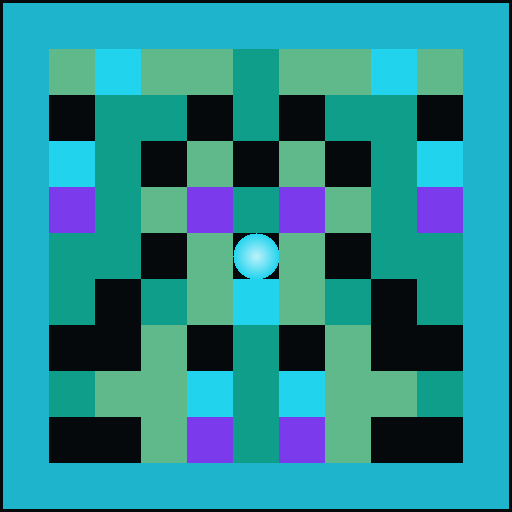
an illustration of the DishBrain loop — neurons firing across a multi-electrode array, a paddle nudged toward the ball. This is a homage, NOT a neural simulation.
The Reckoning
the bridge, and the honesty about 'alive' and 'aware'
The Bridge
life ⇄ hardware
- The seam where your two domains meet: life-science asks 'what else is a mind?', hardware asks 'what is the substrate?' — here the answer is one object.
- >A rhyme with mitochondria (emergence by merger): biology and silicon fused into a single computing thing.
Two-Layer Honest
capability vs claim
- Settled: organoids are real neural tissue; DishBrain demonstrably learned a task; the energy gap is real.
- Open and contested: whether any of this is sentient or aware. Mainstream view — organoids lack senses, body, and blood supply, so almost certainly not — but the field itself flags caution. Stated as a question, not a verdict.
Render, Not Invent
the footnotes
- Researchers (Hartung, Kagan, Friston, Lancaster, Knoblich, Farahany) are CITED, not minted — all living.
- Emergents are systems and concepts, not people. The interactive below is an illustration of the loop, NOT a neural simulation. No copyrighted text reproduced.
The Roster
the systems, concepts, and open questions as ACI .agents — each a birth certificate & a nature (12)


